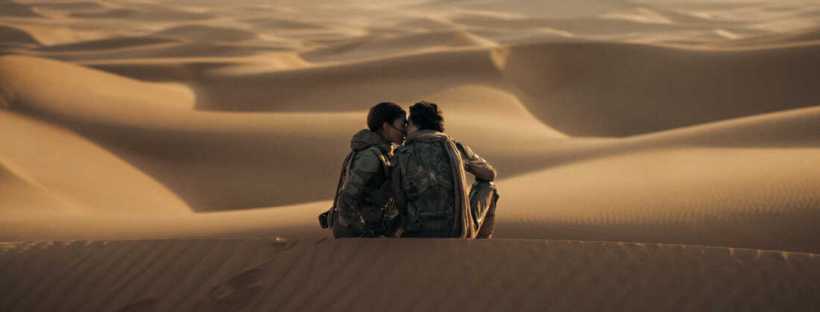
Dune: Part Two (2024, Legendary Pictures)
Featuring Timothée Chalamet, Zendaya, Rebecca Ferguson, Josh Brolin, Austin Butler, Florence Pugh, Dave Bautista, Christopher Walken, Léa Seydoux, Souheila Yacoub, Stellan Skarsgård, Charlotte Rampling and Javier Bardem. Cinematography by Greig Fraser. Music by Hans Zimmer. Screenplay by Denis Villeneuve and Jon Spaihts, based on Dune by Frank Herbert. Directed by Denis Villeneuve.
Warning: these two reviews contain spoilers to Dune: Part One and Dune: Part Two
*****************************************
Reviewed by Robin Stevens
Running at nearly two and a half hours, the much anticipated Dune: Part Two completes Denis Villeneuve’s two-part cinematic interpretation of Frank Herbert’s 1965 epic novel. The story of Dune is a complex saga of politics: loyalty and betrayal, manipulation and raw brutality, similar to the power politics of the Roman Republic expressed through the writings of Shakespeare’s Julius Caesar and Robert Graves’ I, Claudius. This ancient world-feel is further reinforced in the contests of power through brutal gladiatorial contests and spectacular scenes of well-trained armies using blades in hand-to-hand combat. It is epic.

To set the scene: deep into the future, the universe is run by a series of ‘Houses’ of noble birth (Atreides, Harkonnen and Corrino), who manage various planets under the overlordship of Emperor Padishah Shaddam IV. There is intense rivalry between the Houses, and the Emperor maintains his power by playing them off against each other. They all rely on ‘spice’ mining – spice is the most valuable and essential commodity in the universe. Its source is on the planet Arrakis, otherwise known as Dune due its desert landscape. Whoever manages Dune is in a powerful position. The indigenous Fremen are reduced to servitude or forced to live in remote and hostile regions on the planet, while a powerful but less overt force called the Bene Gesserit, a centuries old, female, priest-like order, secretly manipulate each of the Houses and the Emperor himself to control the destiny of the spice.
Like the first film, Dune: Part Two stays more or less faithful to the novel. It is a complex novel with lots of characters and mini-plots and manoeuvrings – but there is only so much that can be fitted into a few hours of film. So a few characters have been cut, times scales have been condensed, and Villeneuve has expanded the role of a few of the female characters. But all in all it is a good adaptation of the book.
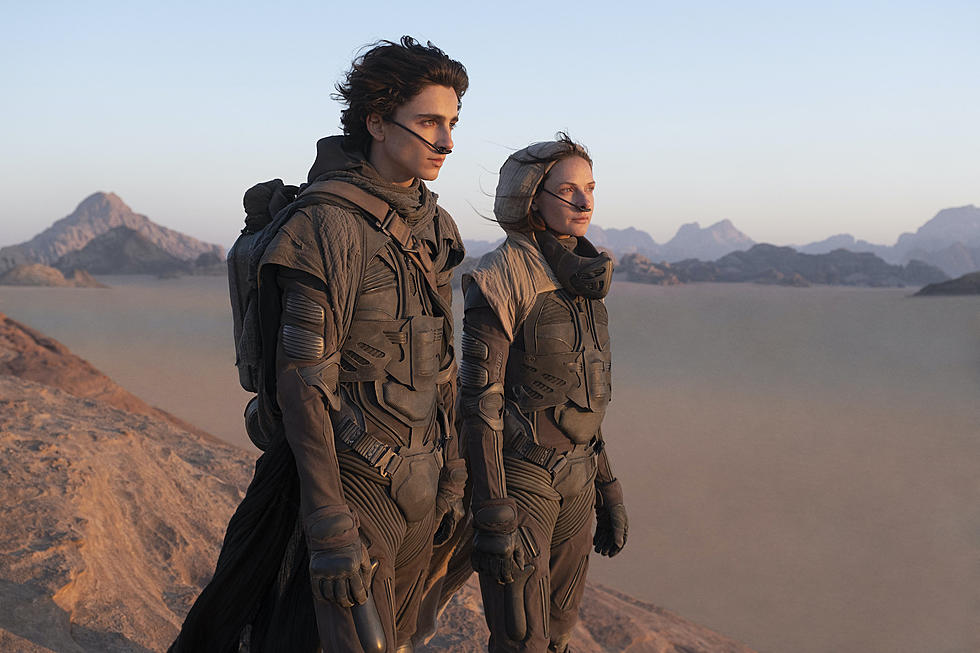
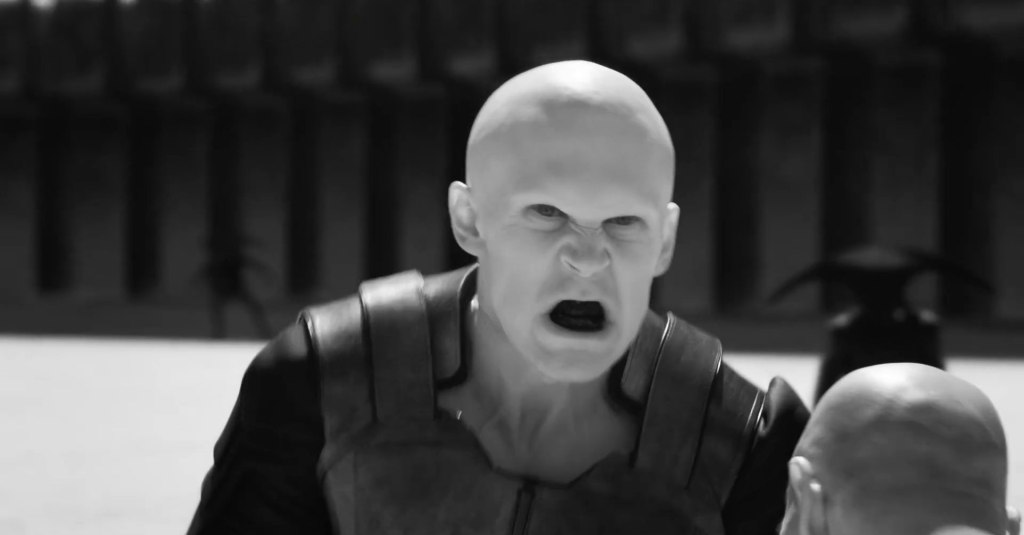
In considering the technical aspects of the film I single out the musical score and soundtrack by Hans Zimmer. To some degree it makes the film: it is perfectly pitched, and sets the mood and pace. It has a modern synthetic, resinous metallic tone, laced with orchestral melodies. Zimmer did the soundtrack on the 2021 film as well and though I liked it, it occasionally boomed over the audience. In this second film it is more balanced and beautifully timed with the visuals. Powerful but not overpowering. Cinematography is by Greig Fraser, who worked on the earlier film too. It is an improvement as it is a little less dark for starters. While Dune (2021) was visually closeted, much of it filmed in dimmed interiors (with a few exceptions), Part Two is full of epic scenes of a desert landscape, battle sequences, and palatial surrounds. Some sequences are shot fully in black and white, e.g. the Harkonnen planet Giedi Prime, over which shines a ‘black sun’, is stunningly shot and provides a sense of constant danger. The visual elements of the film are aided by superb CGI effects, as well as great set and costume design. I cannot fault it – and it’s one of the things I look for (I know, I’m a bit strange that way!). With a film this complex, and with so many indoor and outdoor scenes, only an expert editor – working alongside the director – can turn a bunch of reels into a highly watchable film.
Villeneuve has assembled an outstanding cast. Timothée Chalamet’s raw energy and sometimes wavering doubt makes him a much more believable Paul Atreides than earlier and slightly sterile incarnations (such as Kyle McLachlan in David Lynch’s 1984 film). Zendaya plays Fremen fighter Chani, and slowly becomes Paul’s partner. She does a fine job, but I think sometimes she is a little over-shadowed by others, which is no fault of hers. The actors who play Bene Gesserit characters all give dynamic and nuanced performances: Rebecca Ferguson (Jessica), Charlotte Rampling (Reverand Mother Mohiam), Florence Pugh (Princess Irulan) and Léa Seydoux (Lady Margot Fenring). Stellan Skarsgård (Baron Vladimir Harkonnen), Austin Butler (Feyd-Rautha) and Dave Bautista (Beast Rabban) all give affecting performances matching their varied but psychopathic characters. Christopher Walken as the Emperor was a good touch – small scenes, big impact. Javier Bardem’s Stilgar is excellent, and his fellow Fremen-portrayed actors (Giusi Merli, Souheila Yacoub and Alison Halstead) are all well-cast.
The script is good, and without doubt the best adaptation of Herbert’s novel to date. But this film is unmistakably Villeneuve’s. His stamp is all over it. Good actors, epic scenes, detailed attention to mood and authenticity. There’s something of a chain of previous events and previous sci-fi films, which led to these two movies. Others have pointed out that the 1965 novel Dune was influenced by the emerging oil crisis in the Middle East in the 1950s, where powerful nations competed for trade in oil – something analogous to the all-valuable desert ‘spice’ exploited by the various powerful ‘Houses’, and where few benefits flow to the less developed desert-dwelling peoples. It’s significant too, to point out that the novel also shortly followed David’s Lean’s 1962 epic film Lawrence of Arabia, where the Englishman T. E. Lawrence unites disparate Arabic tribes to engage in guerilla hit-and-run tactics to defeat foreign powers in the region (this was based on Lawrence’s 1926 book Seven Pillars of Wisdom). Indeed, the Fremen are clearly based on Bedouin tribes.
There are some wonderful scenes in Dune: Part Two. Beautiful desert landscapes, heavily armoured airships and assault craft, as well as stark or ornate interiors. The sandworms are impressive, especially when they emerge out of the dust in such a dramatic fashion. This film has a lot more action than the first instalment (as you’d expect), and several characters have greater depth. That is especially so for several of the female characters, e.g. Princess Irulan and Chani. With an excellent soundtrack assisting, the tension is ramped up and there is a satisfying conclusion…except, there is not a complete conclusion. It is set up for a third film (Dune Messiah), which will be made if this one proves successful enough. All in all, Dune: Part Two makes for an epic cinematic event. And maybe that’s a good way to understand it – it is an event to be experienced – so if you can watch it on a Big Screen and watch it with others, you should. I found it very gratifying and will watch it again.
*****************************************
Reviewed by JJ McDermott
There was a moment when I rolled my eyes watching Denis Villeneuve’s latest sci-fi eye-feast. It occurred in the latter third during a flash-forward scene involving a soon-to-be important character played by a well-known female actor. It was at that point I realised that there will be more movies set in this Dune-verse – indeed, Villeneuve has already confirmed he will complete a trilogy with a film based on Frank Herbert’s second novel, Dune Messiah. So just to be clear, Villeneuve’s parts one and two are based on Herbert’s first Dune novel, and his part three will be based on Herbert’s first sequel, Dune Messiah. But be warned, there are four more sequels beyond that…Muad’Dib save us!

Frank Herbert’s Dune is rightfully regarded as one of the greatest sci-fi novels of all time, and it deserves the best-est of Big Screen treatment in my opinion (sorry David Lynch and Sting fans). Villeneuve’s Part One was an excellent introduction to the story as it masterfully explored the visual depth residing in Herbert’s extravagant descriptions. And he furthers that in Part Two. There is no doubt that the sequel is reaching for bigger, more grandiose moments than the first. His eye for visually splendid landscapes has already been evident in his earlier films (Sicario, Arrival, Blade Runner 2049), but here it is advancing to another level. The desert planet Arrakis is presented in extraordinarily realistic (albeit massively CGI-ed) detail. The armoured concrete bases built by successive colonisers are particularly impressive, as are the physical characterisations of each party in the story, e.g. the evil Harkonnens weird the place out with their striking black eyes and marbled white heads, and the heroic Fremen mesmerise us with their blue eyes, sand-blown faces and incredibly intricate desert-scuba gear. But Villeneuve’s greatest success is his ability to competently hold the complex story together and make it easy to follow– this is no simple feat given the epic proportions of Herbert’s novel.


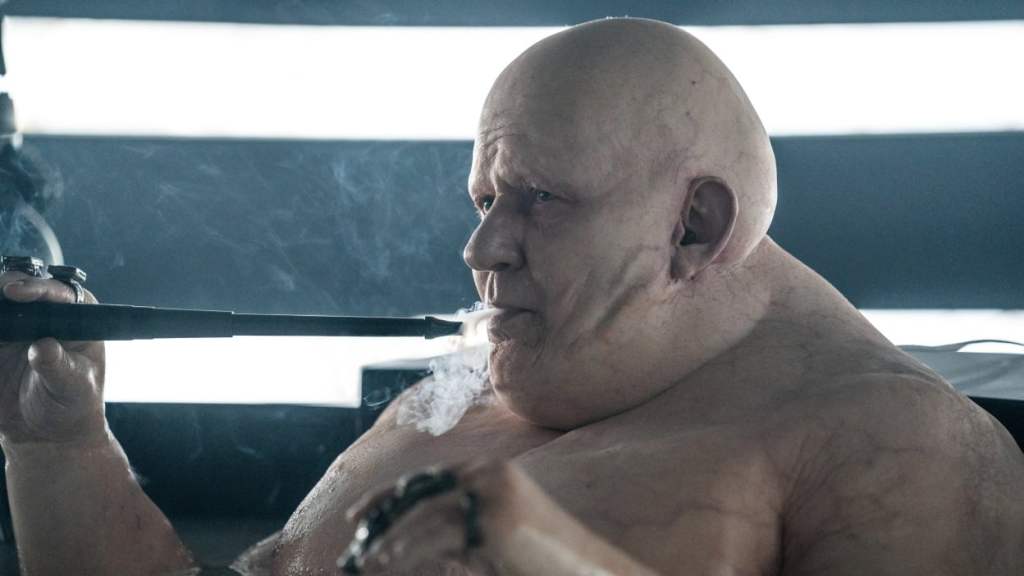

Sparse, mumbly dialogue in modern film is a pet peeve of mine, but the spoken word here is managed very effectively – it does not confuse the viewer and it ensures the visuals are not over-shadowed. In fact, in many scenes, action and movement of both camera and character communicates to us in a language of its own. Villeneuve wants Arrakis and its giant sandworms to consume us, and it often does. The story can be very silly at times, but a profound intent is always rising to the surface. Among other things, the basis of Herbert’s novel stems from early to mid-20th Century events in the Middle East, and a critique of Western colonisation is obvious – the Fremen speak in a language akin to Arabic and have belief systems very similar to Islam. Whereas Villeneuve does elevate his film with this background, he also ensures not to neglect the entertainment value. The star-studded cast do a fine job in supplying that, none more so than Javier Bardem as the Fremen warrior Stilgar, whose fanaticism is sort-of played for kicks. But there is also Timothée Chalamet with his perfect hair – he carries the young, often naïve, messiah-in-training Paul Atreides with aplomb. Rebecca Ferguson plays his Bene Gesserit mother with the perfect ambivalent flow that is required. Stellan Skarsgård continues his gross-out Mr Creosote impression as Baron Harkonnen, and Austin ‘Elvis’ Butler memorably pops in half-way through as Harkonnen’s psychopathic nephew, Feyd-Rautha. Zendaya is brilliant too, but her character’s raison d’etre is basically to be Paul’s concubine. This is problematic, but there are enough hints to suggest Villeneuve is trying to deviate from the source material the best he can, and Part Three may see a more nuanced and independent plot emerging there. We all look forward to that.

 Momentary Cinema
One thought on “The Two Reviews – Dune: Part Two”